| Locally licensed entity | Global platform | |
|---|---|---|
| Supervision | AFSA, within the AIFC | Depends on the country you selected |
| Who you turn to | Local complaints route exists | Platform process; cross-border claims are expensive |
| Assets available | Narrower | Considerably wider |
| Tenge fiat rail | More direct local bank integration | Mainly P2P and existing rails |
| Shared accounts | No. Register separately on each. | |
| Suits | Buying, holding and cashing out cleanly | Needing more instruments, or already established |

Why there are two
Binance obtained an AFSA licence in Kazakhstan, becoming the first digital asset platform in the region to hold full regulatory authorisation. Holding a licence means operating inside its framework — supervised locally, following local rules, subject to local inspection.
Those constraints cannot be applied to a platform serving users worldwide. So you get two things: one operating inside a local licence, one outside it serving a global audience. They share a brand and are, legally, different operating entities with separate account systems.
This is not unique to Binance; many international platforms do the same after obtaining a licence somewhere. Once you understand it, you stop wasting time on "why won't my account log in over here".
Why the local entity has fewer assets
Frequently misread as "the local version is the stripped-down one". The causation runs the other way.
Operating under a licence means every tradable asset has to satisfy the regulator's requirements for that asset — has it been reviewed, is disclosure adequate, is the risk profile suitable for retail. That happens asset by asset, not as a single blanket approval. So a newly licensed platform necessarily starts narrow and widens as individual approvals land.
Put differently, the narrower range is not a product team being lazy; it is a direct consequence of the framework. Once you see that, "fewer assets" means very different things to different people: nothing at all if you only want USDT for payments, decisive if you want to trade something obscure.
Worth adding: a wider range is often not an advantage. Thinly traded assets have poor liquidity, wide spreads and delisting risk. For a newcomer, a narrower menu means fewer ways to get hurt.
Choosing: three questions
Three questions, in order, usually settle it: does the local entity carry what I need to trade? Do I care about having a local complaints route if something goes wrong? Does my money mostly move in tenge or in something else? The answers generally point the same way.
If you just want to hold some USDT for cross-border payments
The locally licensed entity fits better. A narrow asset range is not a constraint for you — you only ever wanted one or two things. Its advantages in supervision and fiat rails are concrete: money moves more directly and there is a local path if something goes wrong.
If you already have a global account in use
One thing has to be said before the migrate-or-not question: the two have different regulatory standing in Kazakhstan. The local entity holds an AFSA licence; the global platform is not a locally licensed entity. And AFSA's public warning of 29 April 2026 advised users to check a platform's regulatory status in the public register before using it, and to refrain from transferring funds or digital assets to entities whose regulatory status is unclear.
So I am not going to say simply "keep using it". Migration does have real costs — redoing verification, rebuilding trading history, moving assets, each with its own risk — and those are genuine. But weighing those costs against the fact that the regulator has publicly cautioned users about unlicensed platforms is what makes the judgement complete.
My actual suggestion splits by size: modest amounts, occasional use — decide on cost, no need to go through the upheaval; amounts large enough that losing access would affect your life, or where you will need an explainable compliance trail (for a future source-of-funds question, say) — then regulatory standing should outweigh migration cost. That is not me deciding for you; it is putting both sides on the table.
If the local entity does not carry what you need
Then the question answers itself. Though it is worth asking one thing first: do you actually need those instruments? For most people whose problem is payments, the answer is no. A wider menu is a temptation rather than a requirement.
Practical differences worth knowing beforehand
The table covers structure. These are the ones you only meet in use. Individually small, collectively noticeable.
How usable the fiat rail actually is
"Supports tenge" and "tenge works smoothly" are different claims. The first only says the option exists. The second depends on which local banks are integrated, what the limits are, how fast it settles, and whether it queues at busy times.
None of that is visible from a marketing page; you can only find out by trying. Which is why I keep saying the same thing: whichever you pick, run a small amount in and out first. If it works, you know the route suits you. If it does not, the cost and waiting time depend on the route and the reason it failed.
Support language and responsiveness
Irrelevant while things go well, and everything when they do not. The local entity is generally better in local languages and closer to local working hours; the global platform has broad English coverage but potentially longer queues.
One trap specific to non-native speakers: machine-translating your way through a support conversation tends to distort the problem, and several rounds of that is slower than one clear description. If your issue is complicated, write it in whichever language you write best.
How fast features arrive
New capabilities generally reach the global platform first, with the local entity waiting on the corresponding permission. So if you read about a feature, check it exists on your side before hunting for it using instructions written for the other.
This is a genuine difficulty in writing guides like this one: the same task can sit behind different menus on each. So our procedural guides describe what you are looking for rather than "third menu, second item" — the latter goes stale far too quickly.
Fee structures
Fee schedules and tier systems may differ and may be counted separately. If you have built up volume and a lower rate on one side, moving means starting over.
That matters to frequent traders and barely at all to people making payments. Work out which you are before weighing it.
Can you use both
Technically yes, and for some people it genuinely is the sensible arrangement: the locally licensed entity for what you intend to keep and want on a clean path, the global platform for wider instruments or existing positions. The cost is two accounts to manage, two verifications, and two sets of records.
Read this together with the previous section, though: the global platform is not a locally licensed entity, and AFSA advises users not to transfer funds to entities whose regulatory status is unclear. So within a both-accounts arrangement, whatever sits on the global side should be an amount you have consciously decided to carry after that trade-off — not a default "well, some in each". How much is your call; I am only putting the constraint on the table.
Who this suits: people with genuine local payment needs plus legacy positions on the global platform; traders who need a clean compliance path for source-of-funds questions but also want flexibility; anyone whose holdings have grown enough that concentration itself is a concern.
Who it does not: anyone who just wants a little USDT for day-to-day payments. A second account is pure overhead with no matching benefit.
Four things to settle at the outset if you do run both
Keep records separate and also combined. Each side needs its own history, but totals and tax need the consolidated view. One spreadsheet, two sheets, one summary.
Do the security settings on both. The human tendency is to secure the main account properly and treat the other casually — and attackers go for the casual one. Treat them identically.
Decide which one is primary. A default removes a lot of small decisions: where deposits go, where withdrawals come from, where new assets sit. Without a rule you re-decide every time and it gets untidy.
Do not shuttle assets between them. Every cross-platform move costs a network fee and carries a chance of error. If you are moving funds weekly, the division of labour is wrong and needs rethinking.
Already on one side: should you move
The default answer is no. Migration has real costs: redo verification, transfer assets (network fees and operational risk), leave history behind, and the referral relationship does not travel. Unless you have a concrete, articulable reason, stay.
What counts as articulable? Only a few things:
- Your holdings have grown enough that "is there a local complaints route" becomes the first consideration. The threshold is personal, but if losing it would materially affect your life, you have reached it.
- The fiat rail on your current side does not work well for you. If tenge always has to go the long way round through P2P, switching may just solve it.
- A capability you need is not available on your side. The most concrete reason, because it is a hard constraint.
What does not count: "I heard the other one is more compliant", "everyone I know uses it", "it feels safer". None of those offsets the cost of moving.
If you are going to move, the order matters
Open and fully verify the new account first, confirm funding and withdrawal both work — run a small amount through the whole flow — and only then transfer assets in stages. Deal with the old account last.
Not the other way round. Pulling assets out first and then opening the new account leaves you suspended if verification stalls. For example, in a hypothetical transfer, the receiving account might still be awaiting verification. Check its status and requirements before moving assets.
Also: do not rush to close the old account. Its history can matter for tax and source-of-funds questions, and once closed you cannot retrieve it. Leaving it dormant costs nothing.
Three common misreadings
"The local one is cut down, so it is worse." The narrower range follows from the licensing framework, not from product quality. For your actual purpose you will probably never touch what is missing.
"Register once and I have both." You do not. Both need separate registration and separate verification — which is exactly why it is worth deciding before you sign up, rather than doing KYC twice.
"It's Binance either way, so they'll cover it." Group branding and legal entity are different things. Your rights come from which entity you contracted with and who supervises it. Treating a brand as a guarantee is treating a feeling as a contract.
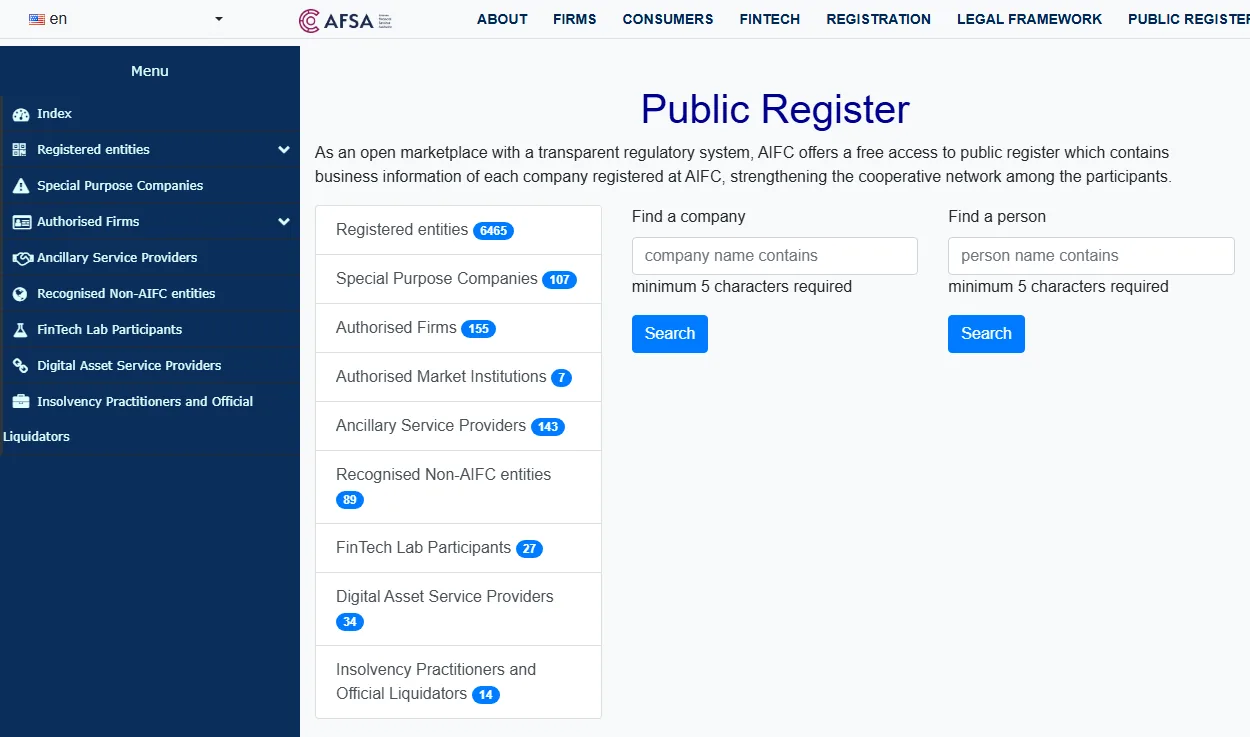
Whichever you choose, verify a platform's licensed status in the AFSA public register rather than from wording on its own site. How to check has its own guide and a checklist tool.
One practical question that comes up often: does the referral code work on both? No. Attribution is tied to a specific account system and does not follow you across. So if you intend to open both, make sure the code goes in during each signup — the same reason the signup guide stresses that it cannot be added afterwards, counted once per side.
Risk notice: crypto prices move violently and you can lose everything you put in. Service scope, available assets and fiat rails change with regulation and business decisions — whatever each platform shows on its current page is authoritative. Some jurisdictions restrict crypto assets, so check the rules where you are.
What I checked for the two platforms
Which entity answers to which regulator is not something a platform’s own marketing page can settle. Regulatory status here comes from the regulator’s register; everything else comes from each side’s published terms.Checked September 2026
- AFSA public register of regulated entities Astana Financial Services AuthorityThe difference in regulatory standing between the two entities can be checked here yourself.
- AFSA warning on unlicensed digital asset platforms (29 April 2026) Astana Financial Services AuthorityThe regulator's public warning is the direct reason the 'should you move' section reads the way it does.
- Regulation of the digital assets market National Bank of KazakhstanWhich regulator covers which kind of platform determines who you can turn to if something goes wrong.
- Unsecured digital asset exchange operators: licensing conditions National Bank of KazakhstanThe actual bar for a local licence, useful for judging how much the word 'licensed' is worth.
- Law of the Republic of Kazakhstan No. 193-VII On Digital Assets (6 Feb 2023) Adilet legal information systemThe statutory source of the two coexisting regimes.
- AFSA news and announcements Astana Financial Services AuthorityLicence status changes; check the latest announcements before deciding.
- Kazakhstan introduces regulation of digital asset circulation (announcement, 30 Apr 2026) National Bank of KazakhstanThe regulatory landscape after May 2026, on which this comparison is built.