
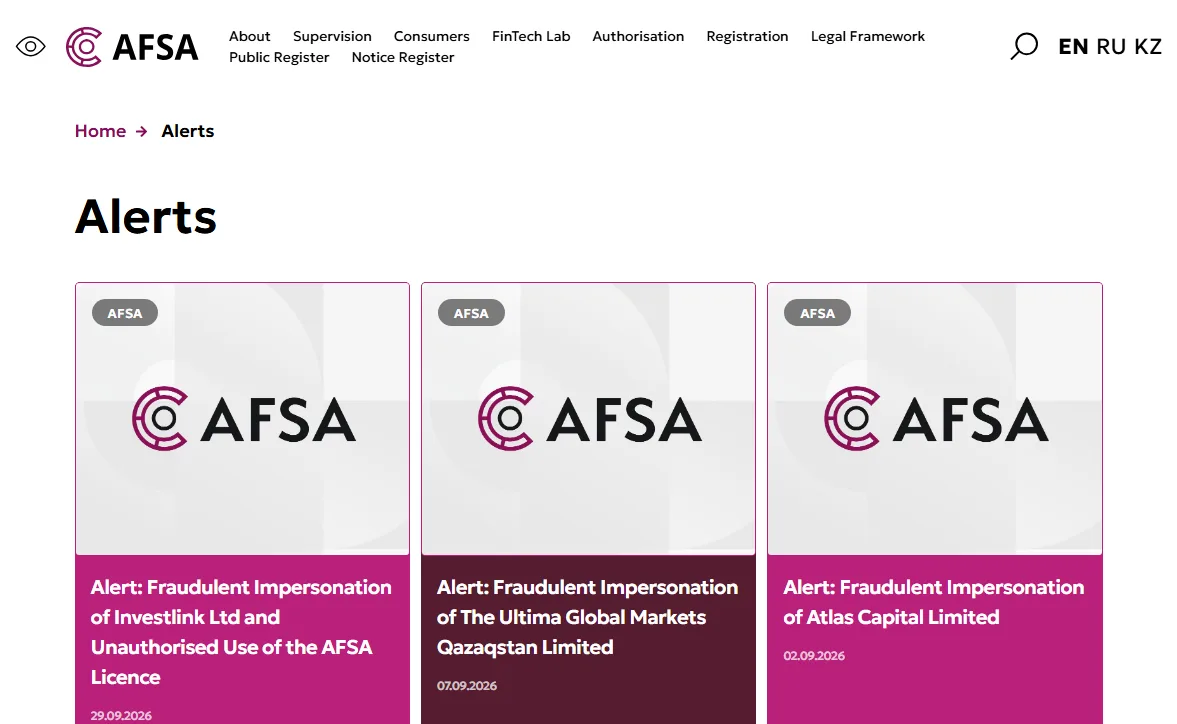
A genuine AFSA licence certificate in a Telegram channel proves one thing: the company named on it is licensed. It says nothing about who runs the channel. In an alert dated 29 September 2026, the Astana Financial Services Authority described a channel that used a real licensed firm's name, logo and licence number, and was not run by that firm.
So the useful question is not "is there a licence?" but "does this channel belong to the licence holder?" The patterns below are taken from AFSA's own Alerts page, covering April 2025 to September 2026.
Three ways AIFC firms get impersonated
A Telegram channel wearing a real firm's name. The Investlink Ltd alert of September 2026 is unusually detailed. The channel used the handle @investlink_kz, which reads like the firm's Kazakhstan account. It displayed Investlink's real AFSA licence number, AFSA-A-LA-2021-0037, and copied the firm's marketing: a 3.25% yield on USD cash balances, USD 1,000,000 of asset insurance. Then came the pitch — a copy-trading scheme advertising 10–15% a month. People were told to open an account with a third-party broker, fund it, and hand control to an account called @manager_crypto_trader. Investlink confirmed it had no connection to any of it.
The one that matters most for crypto users came in August 2026. AFSA found a Telegram group, AtaixChat, using the name, branding and visual style of ATAIX Eurasia Ltd., a licensed digital asset trading facility in the AIFC. No connection to the real exchange.
A website displaying a genuine certificate. In August 2026 AFSA flagged a website, on a domain with no link to finance, that put AFSA's name front and centre and showed a copy of Freedom Finance Global PLC's real licence certificate. AFSA's wording is blunt: unauthorised use of an AFSA licence certificate does not give any person, company, website or platform regulatory status.
Pretending to be AFSA itself. In May and July 2025, AFSA warned about websites copying the design and content of its own site; one was regfs.it.com, with a contact address that has nothing to do with AFSA. The likely aim, AFSA says, is harvesting personal and financial data. A cruder version simply borrows the logo. In April 2025, social media accounts calling themselves “MBus Exchange” offered crypto exchange while showing the AFSA logo. AFSA found no entity of that or a similar name in the AIFC and said the activity had the hallmarks of fraud (Article 190) and illegal business activity (Article 214) under the Criminal Code.
Why a real certificate proves so little
The Investlink and Freedom Finance alerts of 2026 both close with the same three warnings. Paraphrased:
- fraudsters may copy genuine licences, certificates, company names, logos and registration details;
- an AFSA licence certificate displayed on a website does not by itself confirm that the site's operator is authorised;
- before transferring money or personal data, verify the entity independently, and make sure the online source is an official source of the AIFC participant.
That last clause is the one people skip. The public register answers whether a company is licensed and for what; our register guide walks through its columns. It does not say who owns a given Telegram channel or domain. For that, work backwards: ignore the link you were sent, type the firm's website address yourself, see which channels it lists, and compare.
Sometimes AFSA does this for you. The Investlink alert lists investlink.io, investlink.kz and the Telegram account investlink_io. The fake was investlink_kz — two letters apart. The Freedom Finance alert names fbroker.kz as the real site.
“AFSA” calls offering to get your money back
Suppose you have already lost money on a platform, and then someone calls claiming to be AFSA, or simply “the financial regulator”: your losses have been traced, and a fee, deposit or “unfreezing charge” will release them.
AFSA has answered this in writing, in both of its cloned-website alerts:
- it does not make payments, reimbursements or refunds via third parties, unofficial websites, social media or messaging apps;
- its fees are published in the fee rules on its website, and it never asks for payment by personal message, SMS or through intermediaries;
- its only website is afsa.aifc.kz, and it communicates only through contact details published there.
Recovering fraud losses is not something AFSA does for individuals in any case. That is the bank's and the police's job.
Checks before you send anything
Work through these in order. Most fakes fail at step three.
- Search AFSA's Alerts page. Try the channel name, the site name and the company name. Alerts usually quote the fake handle or domain. Nothing found means not yet flagged, not safe.
- Check the public register. Compare the full English registered name letter by letter, and check the licence covers what you are being asked to do. Investlink is licensed for advising and arranging deals; managing someone's trading account is not on the list.
- Find the firm's channels from its own site. Type the address yourself, or use the one in the AFSA alert. A handle with a different suffix or a domain with a different ending is a different owner.
- Follow the money. Licensed firms take client money into accounts in their own name. A personal card, a personal Kaspi account, a bare wallet address, or a “manager” who wants your login is where the Investlink scheme ended up.
- Read the return as a warning. 10–15% a month appeared in a channel AFSA named as fake.
Our AFSA register lookup handles the first pass on names and licence types. Step three is still yours to do.
After the money has gone: bank, then police, then AFSA
AFSA's advice, if you entered details on a suspicious site or were defrauded, is to contact your bank and law enforcement immediately. Only those two can stop money moving, so they come first.
Your bank. If you paid by card or bank transfer, call the issuer, say it was a fraudulent payment, and ask whether it can be blocked or the receiving account frozen. If you typed your card number into a fake site, ask for a new card. A USDT transfer cannot be reversed on-chain, so the bank's role is smaller — but if the tenge came from selling crypto, explain that before your own account gets flagged. The frozen-card guide covers that situation.
The police. The police number in Kazakhstan is 102. Bring the channel or site link, the scammer's handles, the receiving card number or wallet address, payment receipts and screenshots. The MBus Exchange alert cites Articles 190 and 214 of the Criminal Code; handing officers the link to a relevant AFSA alert does no harm.
AFSA. Send the same material to [email protected] or use the online form on its site. AFSA can investigate, publish an alert and notify the firm being impersonated. It cannot recover funds for you.
Do not pay any “recovery service”. Whether they call themselves lawyers, hackers or AFSA, anyone asking for money upfront to get your money back is, by AFSA's own account above, running the next round of the same scam.
If you were the one receiving a scam victim's money while selling on P2P, that is a different problem: see the triangle scam guide.
Questions
The licence number posted in the group is on the AFSA register. Doesn't that settle it?
No. The register tells you which company holds that number. It cannot tell you who is posting in the group. In AFSA's September 2026 alert about Investlink Ltd, the fake channel displayed the firm's real licence number. You still need to match the channel or web address against the official channels the firm itself publishes, or the ones AFSA lists in its alert.
Someone from “AFSA” says they can recover my losses if I pay a processing fee. Could that be real?
AFSA says it does not make payments, reimbursements or refunds through third parties, unofficial websites, social media or messaging apps, and never asks for money by personal message, SMS or through intermediaries. Its fees are published on its own website. A caller who wants money first is, on AFSA's own description, not AFSA.
I have already sent money to an impersonator. What first?
Call the bank you paid from, say it was a fraudulent transfer and ask whether it can be stopped or the receiving account frozen. Then report it to the police on 102. After that, send the channel link, web address, receiving account or wallet address and chat screenshots to AFSA at [email protected]. AFSA is a regulator, not a police force; recovering money runs through the bank and the police.
AFSA alerts quoted in this guide
All pages opened and checked in October 2026. The fake channels and sites they name may already be gone; this guide relies on AFSA's descriptions and did not visit them.
- Alerts AFSAIndex of all alerts, newest first.
- Alert: Fraudulent Impersonation of Investlink Ltd and Unauthorised Use of the AFSA Licence AFSA, 29 Sep 2026Fake handles, licence number, advertised returns, official channels, hotline address.
- Alert: Fraudulent Impersonation of Freedom Finance Global PLC and Unauthorised Use of the AFSA Licence AFSA, 26 Aug 2026Genuine certificate on a fake site; “confers no regulatory status”.
- AFSA reports the identification of an unofficial Telegram group impersonating an AIFC participant company AFSA, 4 Aug 2026Group using ATAIX Eurasia Ltd.'s name.
- Alert: AFSA warns public on cloned website AFSA, 4 Jul 2025No refunds via third parties, no payment requests by message; contact bank and police.
- Alert: Unauthorised Use of AFSA Website Elements by regfs.it.com AFSA, 23 May 2025A copy of AFSA's website and its contact address.
- Alert: Unauthorised Use of AFSA Logo by “MBus Exchange” AFSA, 9 Apr 2025Crypto exchange accounts using the AFSA logo; Criminal Code Articles 190 and 214.
102 is the police number in Kazakhstan. Whether a bank can block or freeze a fraudulent transfer depends on the bank and on whether the payment has already settled; we have not checked individual banks.