
In a triangle scam the tenge that lands on your card is real. It just does not belong to the person who opened the order. It usually comes from someone who was tricked elsewhere — they think they are paying a rental deposit or buying a used phone, and the card number they were given is the one from your P2P order. You release the USDT, the scammer walks off with it, the victim goes to the police, and the first name on the money trail is yours. Checking that the payer's name matches the buyer's verified name before you release is the cheapest safeguard in the whole process.
What follows is split by situation: you have not released yet, you already have, you are the one who paid and got cheated, or someone wants to "borrow" your card. First, the mechanics.
How the money moves between three people
There are three parties: you, selling USDT on a P2P marketplace; the scammer, who places a buy order with you; and the victim, who is paying for something that does not exist. The sequence runs roughly like this:
- The scammer lists a cheap item or flat on a classifieds site or in a messenger group and agrees a price with the victim.
- At the same time the scammer opens a P2P buy order with you for the same amount and receives your payment details.
- The scammer forwards your card number to the victim. The victim pays, sometimes with a note about the goods or the deposit.
- You see the tenge arrive, confirm receipt and release. The USDT goes to the scammer and is moved on quickly.
- The goods never arrive. The victim reports it, and the bank transfer points to you.
One naming trap: Binance's help centre also has a section called "Triangle Scam", but it describes a different trick — two scammers opening orders with the same seller and recycling one payment proof. The two share a single feature: the person paying you is not the person trading with you. This article is about the first version, the one Russian-language forums call «треугольник».
Why Kazakhstan raises the stakes
Losing the USDT you released is a money problem. In Kazakhstan two newer mechanisms also decide what happens to the tenge sitting on your card.
The National Bank's Anti-Fraud Centre (Антифрод-центр). According to fingramota.kz, the state financial literacy portal, it was set up in July 2024 so that banks and payment firms can exchange data on suspicious transfers around the clock and stop them before the money reaches fraudsters. Press coverage of the rules says that from 31 August 2025 blocked funds are returned on a notice from the criminal investigation body, sanctioned by a prosecutor, and that the recipient's bank must act no later than the next business day. In plain terms: once the victim reports, the matching amount can be pulled from your account, while the USDT you released is gone.
Article 232-1 of the Criminal Code. In force since 16 September 2025, it targets so-called droppers: people who hand control of their bank account or payment instrument to someone else, or receive and forward money for others in exchange for a reward. The Interior Ministry's announcement puts the range from a fine up to seven years' imprisonment with confiscation, depending on the circumstances. Factcheck.kz concluded that ordinary transfers to friends are not caught; what the article means by "unlawful", though, is not spelled out in the public commentary.
If you are selling your own coins with your own money, the article is not aimed at you. The difficulty is that when the incoming tenge is a victim's money, it falls on you to show — with records — that you were a seller, not a collection point.
Before you release: three things to look at
The decision can only be made before you tap "confirm receipt". After that you are in damage control.
The payer's name. Open the incoming transfer in your banking or Kaspi app and compare the sender's name with the buyer's verified name on the order page. Binance's appeal rules are blunt about this: if the name on the buyer's payment account does not match their verified P2P name, the buyer's P2P access is suspended, the seller refunds the full amount, and the order is cancelled only once the seller shows proof of refund and the buyer confirms it arrived. A mismatch is not something to weigh up. Follow the rule.
The payment reference. Victims think they are paying for something else, and it often shows: «за квартиру», «предоплата», «за телефон». You are selling USDT; a note about rent or a phone deserves a hard look. An empty reference, on the other hand, proves nothing.
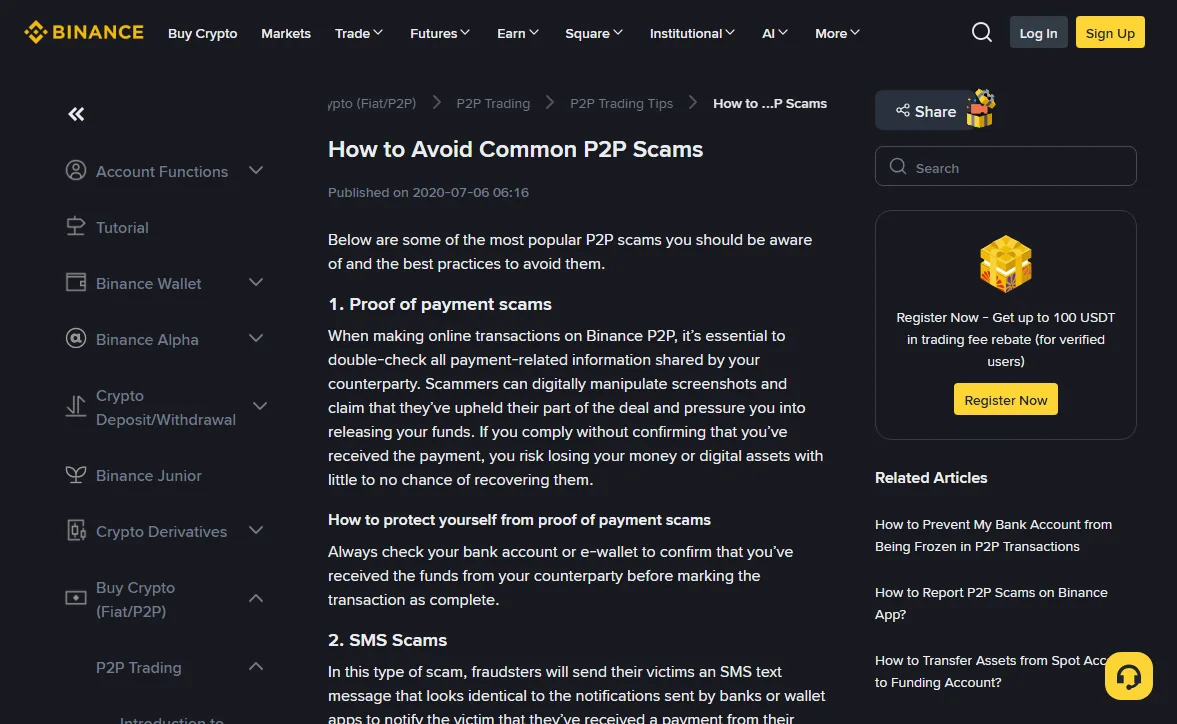
The buyer's behaviour. Pressure to release fast, a push to move the chat off the platform, one order paid in several chunks from different people — any one of these is a reason to stop. Binance's scam guide also tells sellers to remind a buyer who suggests paying from someone else's account that third-party transfers break the P2P rules.
Our pre-trade self-check walks through these points in order before you confirm. It sets out the checks; it does not tell you whether a payment is clean.
Paid, not yet released: hold, then appeal
This is the easy case. The tenge is on your card, the USDT is still in escrow, and nobody has lost anything yet.
- Do not confirm receipt, however hard the buyer pushes. Escrowed coins only move when you release them.
- Open an appeal on the order, citing third-party payment, and attach a screenshot of the incoming transfer showing the sender's name, amount and time. You can mask the card number.
- Refund to the account the money came from, following the support agent's instructions. Binance's guide describes this as refunding "to the sending account".
Refunds go back the way they came. If the buyer asks you to send the money to a different card, that request is part of the scam: you would be passing the victim's money to the fraudster and adding an unexplained transfer to your own history. Keep the refund receipt with the order number.
Already released, then it went wrong
You usually find out in one of three ways: the bank calls to ask where a deposit came from; your card or account stops working; or someone claiming to be the payer contacts you asking for the money.
For the first two, go to the bank and find out whether this is the bank's own risk control or a measure requested by law enforcement. That part is the same as any freeze and is covered in detail in the frozen-card guide. The difference here is that you need a complete evidence trail for this one order:
- the P2P order number, time, amount, and the buyer's nickname and verified name — as much as the order page shows;
- the bank statement line for the deposit, with the sender's name visible;
- the full in-platform chat, especially any pressure or requests to move elsewhere;
- the record of the USDT release, plus the appeal record if you opened one.
The third scenario is where people slip. A caller says they are the payer, they were cheated, please send it back directly — do not transfer anything privately. You cannot confirm who is on the line, whether they have already filed a report, or whether the bank will claw the same amount back again on a police notice. The safer answer is: please report it to the police, and I will cooperate with the police and the bank. That is the channel the return mechanism is built around.
If the police contact you and a criminal case is involved, going with a licensed lawyer is safer than explaining things on your own.
If you are the one who paid
Now the other side. Say you paid a deposit or bought something online, the seller gave you a stranger's card number, and after the transfer they vanished. Speed matters more than anything else.
- Call your own bank immediately and say it was a fraudulent transfer. fingramota.kz puts it simply: a quick reaction is the key to keeping your money.
- Report it to the police. fingramota.kz recommends filing through eOtinish, the government's online appeals platform; in an emergency, dial 102.
- Do not try to settle with the P2P seller who received the money. They were most likely used too, formal returns run through a law enforcement notice, and private contact leaves room for a second scammer.
Press coverage adds one limit: the return procedure applies to transactions registered after the Anti-Fraud Centre went live on 22 July 2024.
Someone wants to use your card for P2P
The pitch tends to go: "Just give me a card. Money comes in, you pass it on, you keep a cut." That is precisely the conduct Article 232-1 describes — letting someone else use your account, or moving money for others for a reward. Say yes and you stop being a seller who got unlucky; you become a link in the chain.
The article carries a note: a first-time offender who comes forward voluntarily and actively helps uncover the offence is exempt from criminal liability, provided no other offence is involved. Anyone already drawn in should have a lawyer look at that note. Anyone who is not should simply refuse.
Where exchanging money for other people turns into unlicensed business is covered in the unlicensed P2P guide, and the personal use or business check helps you lay out your own situation first.
Questions
The sender's name differs from the verified name by a letter or two. Does that count?
Transliteration between Latin and Cyrillic often varies, so a spelling difference is not automatically a third-party payment. If you are unsure, do not release; ask in the order chat or open an appeal and let the platform check.
I refunded to the original account and the bank still restricted my card. Now what?
Give the bank the refund receipt, the order number and the appeal record, and explain that the money has gone back to the payer. A refund does not lift the bank's measure by itself, but it is the strongest evidence you have.
Are the rules the same on Binance Kazakhstan?
This article quotes the public rules in the global Binance help centre. Whether licensed local platforms have identical appeal and refund terms was not checked; their own user agreements govern. The Anti-Fraud Centre and the Criminal Code apply regardless of platform.
The law, the regulator and the platform rules
Two details of the return procedure — the 31 August 2025 start and the next-business-day deadline — are so far only available from press reports; the regulator's own text was not found. Those entries are marked.Links checked September 2026
- Anti-Fraud Centre: first results fingramota.kz (financial literacy portal)When the centre was set up; advice to call the bank first and report via eOtinish.
- Anti-Fraud Centre results (published February 2026) National Bank of KazakhstanThe official report on funds blocked and returned.
- The bank blocked money because of fraudsters: how to get it back Tengrinews (media)Source for the prosecutor-sanctioned notice, the next business day, the 31 August 2025 start and the 22 July 2024 cut-off; a press report, statutory text still to be verified.
- Kazakhstan introduces criminal liability for dropping Kapital.kz, citing the Interior Ministry press serviceEffective date and penalty range of Article 232-1.
- Criminal Code of the Republic of Kazakhstan Әділет official legal databaseThe current wording of Article 232-1 and its note.
- Does sending money to a friend really carry six years? Factcheck.kzA fact check on how far Article 232-1 reaches.
- How to Avoid Common P2P Scams Binance help centreThe platform's definition of a triangle scam, third-party payments and refunding to the sending account.
- Binance P2P Appeal Handling Rules Binance help centreRefund and cancellation rules when the payer's name does not match; page dated 15 October 2024.