
If the platform holds an AIFC licence, there is a set order: complain to the platform in writing, take it to the regulator (AFSA) if the answer doesn't satisfy you, and go to arbitration or the AIFC Court if what you actually want is your money. AIFC rules make licensed firms run a written complaints procedure. That means acknowledging your complaint in writing, investigating it and sending you a written outcome. For claims up to USD 150,000, the AIFC Court has a fast-track Small Claims Court.
None of this applies to a platform without an AIFC licence. In its announcement on the court injunctions, AFSA said that clients of unlicensed platforms do not get the protections licensed firms must provide, and it named complaints handling and dispute resolution among them.
Which company is your contract actually with?
One brand can run an AIFC-licensed local entity and a separate global entity side by side, with different terms, a different regulator and a different complaints route. Whether AFSA is on your escalation path depends on the legal entity named in the terms you accepted at sign-up. The Binance Kazakhstan vs global piece walks through one example.
Open the terms, copy the full legal name of the contracting entity, and search the AFSA Public Register for that exact name. Check the licence type and status. How to read the register explains the four columns, and the register checklist does it step by step.
One group of platforms needs its own mention. On 15 September 2026, acting on claims brought by AFSA, the AIFC Court barred the operators of BingX, Bitcoin.com, Huobi Global (HTX), BitMart, Coinbase, LBank and WEEX from providing digital asset services in the AIFC without a licence. LBank blocked access from Kazakhstan on its own and was removed from the order on 18 September, leaving six. AFSA said the orders would also go to Google Play and the App Store so they could restrict access to those apps by region. If your funds are on one of these six, the AFSA complaint and AIFC dispute routes below don't apply to you. Moving what you can to a platform you have checked matters more than drafting a complaint.
This guide also leaves out platforms licensed by the National Bank outside the AIFC. AFSA says it has been working with the National Bank on this sector since May 2026. We found no official guidance on which body handles complaints from those clients.
Step one: a written complaint, and what the platform owes you
AFSA's complaint review page is explicit about the order. You contact the authorised firm before you contact AFSA. You can do it in person, by phone or in writing, and AFSA says writing is best because it creates a record you can keep a copy of. The page exists in Russian and Kazakh; the screenshot below is the Russian one.
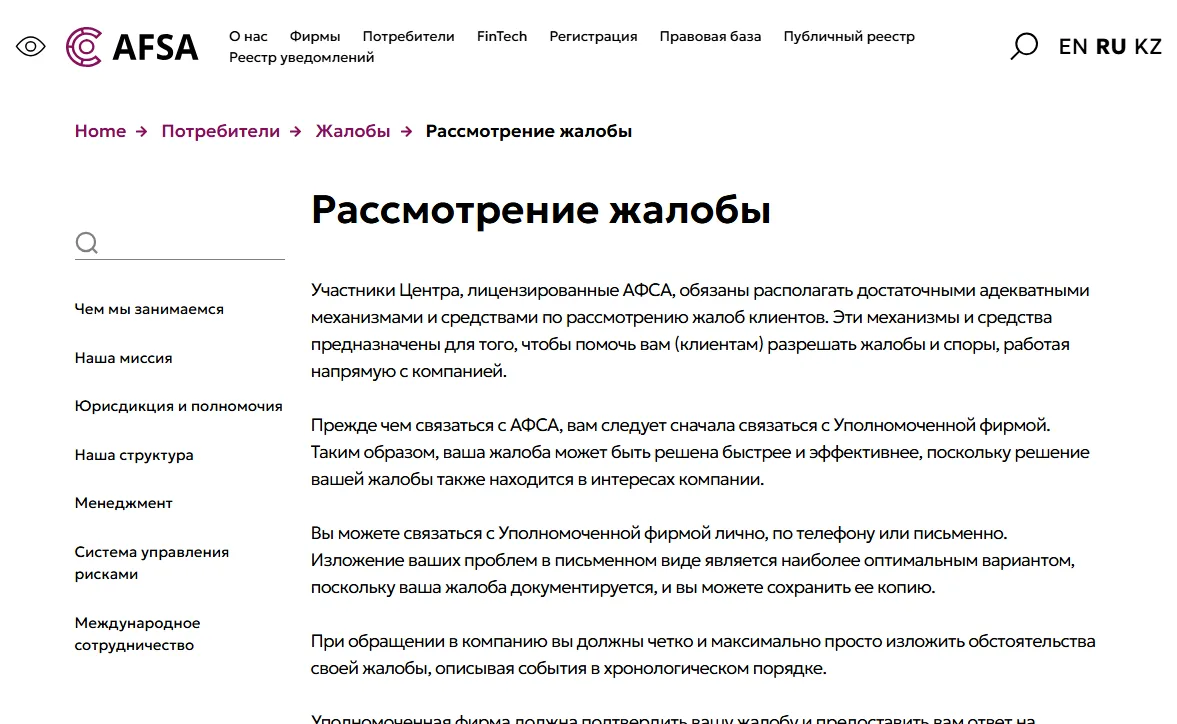
The firm's obligations are in Chapter 15 of the AIFC Conduct of Business Rules (COB). The guidance in the AIFC Digital Asset Activities rules (DAA) lists COB Chapter 15 among the provisions that apply to digital asset trading facility operators. Once your complaint arrives, the firm must:
- acknowledge it promptly in writing (COB 15.2.4). AFSA's guidance treats 7 days as enough for most complaints;
- tell you who is handling it: their contact details, the key points of its complaints procedure, and a statement that you can get the full procedure free of charge (15.2.2 and 15.2.4);
- investigate, and update you where appropriate. AFSA expects an update if resolution takes longer than 30 days;
- give you the outcome in writing, with any proposed redress (15.2.5). The guidance says 60 days from receipt should be enough to resolve most complaints;
- if you reject the redress, tell you what other routes exist, with contact details on request. The guidance gives arbitration and the AIFC Courts as examples.
Those 7, 30 and 60 days sit in guidance notes. They show what the regulator expects. They are not penalty clauses. Quoting them when you chase the firm is fair. Telling the firm it is “breaking the law” on day 61 goes further than the text does.
AFSA asks for a clear account in date order. For a crypto platform, put these in the letter:
- the email you registered with and your account number;
- the transaction: withdrawal or order ID, time (with the time zone), asset, amount, network and destination address;
- what support has already told you, with screenshots in date order;
- one sentence on what you want: release this withdrawal, refund this fee, or explain why the account is restricted.
A platform will not necessarily log an in-app chat as a complaint. Open with a line that says this is a formal complaint (“This is a formal complaint”, or in Russian “Это официальная жалоба”), and ask for a copy of the complaints procedure in the same message. If you later escalate, AFSA will want proof that you complained and what the firm replied.
Step two: taking it to AFSA
AFSA only considers complaints made in writing. Its Russian page says a complaint should include your name, address, phone and email, the same details for the firm and for the people you dealt with there, and a timeline with dates and times where possible. Attach everything relevant, including your earlier complaint to the firm and its reply. If you have already gone to court, tell AFSA who your lawyer is and whether it may contact them.
There are two ways in. The Russian and Kazakh pages point to an online complaint form. The English Complaints page gives the AFSA Hotline Services portal as the primary channel, plus the email [email protected]. You can report anonymously. The English page warns, though, that an anonymous report without enough verifiable detail may be put on hold. When the complaint is about your own money, leaving contact details is the practical choice.
The English page sets out what happens next. AFSA registers and acknowledges a report within 5 business days and gives it an initial review. Substantive feedback normally comes within 3 months, and complex cases can take up to 6. If AFSA refers the case to an outside body, it tells you and usually sends a high-level update every 60 business days.
The complaints AFSA deals with include unauthorised activity, breaches of AIFC law and “misuse of client assets or money”, so a platform sitting on your coins or charging fees it shouldn't is within scope. What the page never says is that AFSA will award you compensation or order the firm to pay you. AFSA polices whether the firm follows the rules. Getting the money back is a separate track.
The scam that turns up mid-complaint: someone claiming to be from AFSA, or a “recovery lawyer”, offers to get your money back for an upfront fee. AFSA's complaint pages mention no fee at any stage. Spotting fake AFSA channels covers how to tell.
Step three: getting money back through arbitration or the AIFC Court
COB guidance names arbitration and the AIFC Courts as the other ways to resolve a complaint. Which one applies starts with the terms. Look for a section called “Dispute resolution” or “Governing law”. An arbitration clause usually sends you to arbitration first, though the wording of the clause decides. A clause choosing the AIFC Court, or a dispute that arises from activity carried on in the AIFC, points to the court.
The court's own description includes a few points that matter to an individual user:
- it is separate from Kazakhstan's ordinary courts and runs on procedure modelled on English common law, with a Court of Appeal whose decisions are final;
- it has exclusive jurisdiction over disputes arising out of AIFC activities and operations;
- claims up to USD 150,000 go through a fast-track procedure in the Small Claims Court;
- its eJustice system lets you file online without travelling to Astana, and hearings can be held by video when the judge decides an in-person hearing is not needed.
Fees follow the court's Practice Direction No. 1. The court's site has a fee estimator that asks for the contract date, whether you are an individual or a company, and whether the claim is monetary. Run your own case through the estimator before filing.
Whether to hire a lawyer, and whether a claim is worth it, depends on the amount and your evidence. Either way, the paper trail from the first two steps feeds straight into this one: your complaint, the firm's written reply, AFSA's acknowledgment. That is the reason to put each step in writing rather than on the phone.
When a withdrawal is held for a compliance review
Not every stuck withdrawal is a dispute. Under anti-money-laundering rules, a licensed platform can ask where your funds came from or ask for more identity documents, and it can pause withdrawals while it reviews them. A complaint sent at that point will usually get the reply “please send the documents first”. Read the platform's email or in-app message for exactly what it wants, and send that. Proving the source of crypto funds lists the records that work for tenge from USDT sales.
If you have sent everything and heard nothing for a long time, or the platform can't say what it needs or why it is holding the funds, go back to step one. Note in the letter which documents you sent and when, and when the platform confirmed receipt. Those dates are what AFSA will want to see later.
Questions
The platform keeps saying “under investigation” and never replies in writing. Can I go straight to AFSA?
AFSA asks you to go to the firm first and to attach your earlier complaint and the firm's reply. If no written reply ever came, attach your complaint, the date you sent it and your follow-ups, and say you received no answer. The rules' guidance expects acknowledgment within 7 days and an update after 30. Both dates are worth putting in your letter.
What language should the complaint be in?
We found no language requirement in AFSA's pages or in COB. AFSA's site runs in English, Russian and Kazakh, and a platform's own complaints procedure usually says which languages it accepts, so check that first. If in doubt, write in English or Russian and attach translations of anything in another language.
Where the rules come from
All pages and files checked in October 2026. COB is version 17 (13 January 2026) as published on the AIFC site; DAA is the version in force from 1 January 2025. If a newer version has been published, the AIFC site prevails.
- Рассмотрение жалобы AFSAFirm first; writing is best; AFSA only takes written complaints; what to include and attach.
- Complaints AFSAWhat AFSA does and doesn't deal with; Hotline portal and [email protected]; 5 business days to register; 3 to 6 months for feedback.
- AIFC Conduct of Business Rules AIFCChapter 15: written acknowledgment, 7- and 60-day guidance, 30-day updates, informing the client of other means.
- AIFC Rules on Digital Asset Activities (DAA) AIFCChapter 2 guidance: COB Chapter 15 applies to digital asset trading facility operators.
- AIFC Court Issues Injunctions Against Operators of Several Unlicensed Crypto Platforms AFSA newsThe 15 September order, LBank's removal, and the statement that unlicensed platforms' clients lack complaints handling and dispute resolution protections.
- About AIFC Court AIFC CourtIndependence from national courts, exclusive jurisdiction, USD 150,000 small claims, eJustice filing.
- Fees AIFC CourtPractice Direction No. 1 and the estimator's inputs.
This sets out the complaint routes in the published rules. It is not legal advice on your dispute.