
A bank asking where your money came from is not the same as a frozen account. It is a request for documents, and under Kazakhstan's anti-money-laundering law the bank is expected to ask when it needs to. Things only escalate — a refused transfer, suspended operations — when what you send back does not add up. So the job is not to sound convincing. It is to connect four things with records whose dates and amounts match: the original money, the platform, the sale into tenge, and the deposits on this card.
This piece covers what gives the bank the right to ask, what each of those four links needs, and how to put a short written explanation together. If your card is already blocked, the order of steps is more urgent — start with the first 72 hours after a freeze.
Why the bank is allowed to ask, and how far it can go
Two things sit behind the question: the law, and the contract you signed when you opened the account.
The law is No. 191-IV of 28 August 2009, on countering money laundering and terrorist financing. Article 5 requires "subjects of financial monitoring" to run due diligence on clients, which includes ongoing review of their transactions and, where necessary, obtaining and recording information on the source of funds behind them. Banks are on that list. So, under the current wording of Article 3, are operators exchanging unsecured digital assets and operators of digital-asset trading platforms — which means a locally licensed crypto platform asking about your funds is working from the same statute as your bank.
Article 13 deals with refusal and suspension. Where due diligence cannot be completed, the operation is to be refused; where there is suspicion that the relationship is being used for laundering, it may be refused. The binding text is the current version on the Әділет legal database. Suspension periods differ between clauses, and we are not going to paraphrase them into a single number.
The contract side, using Kaspi as the example: its published Conditions for Electronic Banking Services say in clause 7.4(3) that the client must provide the documents and information required under AML law, currency-control law and the bank's internal rules, within the deadline Kaspi sets. Clauses 7.1(3) and 10.1(6) give the bank the right to suspend operations on your accounts, or refuse a payment service, in cases provided for by AML law. Other banks word it differently; look for the "условия" or "договор присоединения" document on your bank's site.
In practice there are two outcomes. The documents match, and that is the end of it. Or they are missing or contradict each other, and the bank can refuse the transfer or suspend operations. What you control is what you send.
Four links, not one number
"Source of funds" sounds like a question about income. For crypto-related deposits, the bank is really checking whether four links join up end to end:
- The original money. Salary, business income, savings, the sale of a car or flat. Nothing crypto about it — payslips, contracts, tax records.
- Into the platform. Which card paid, on which platform, on what date, for how much.
- Into tenge. How the coins were sold — on a licensed platform with a withdrawal, or peer-to-peer to individuals.
- Onto this card. Which sale each of the queried deposits belongs to.
The usual gap is between the first link and the fourth. Say you bought USDT from your salary two years ago and sold it in several pieces this year. The deposits are all there; which card paid for the original purchase may not be. Do not fill the gap with a guess. Set out the links you can document, mark the one you cannot ("older records; below is what could be retrieved"), and attach that year's salary statements instead.
If the coins were never bought — a client paid you in USDT, say — link one becomes the invoice, the contract or the order confirmation. For trade payments in USDT, this piece goes through what to keep at each step.
The exchange leg: what an account statement proves, and what it does not
Links two and three live inside the exchange. Binance is used here because its help centre spells out the export features; other platforms name things differently but work along similar lines.
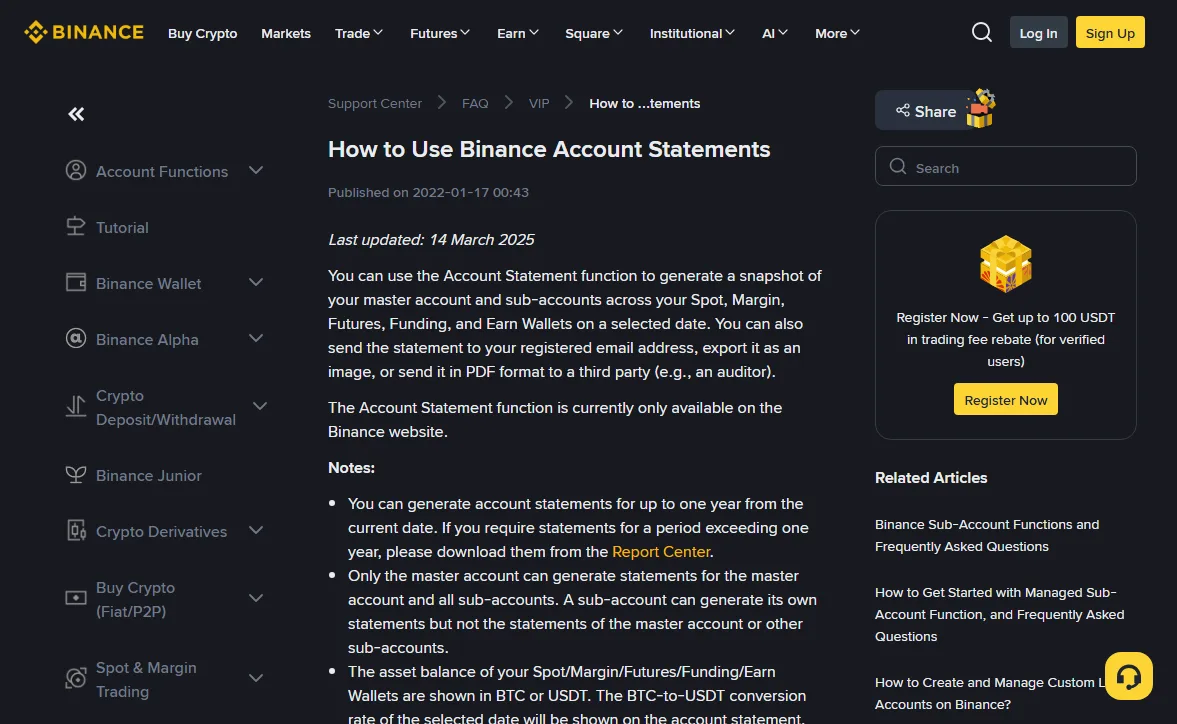
The account statement is generated on the website under Wallet → Account Statement. It is a snapshot of balances on a chosen date across the spot, margin, futures, funding and earn wallets, with the total valued in BTC or USDT. You can email it to yourself, save it as a JPEG, or send it as a PDF to a third party; the page's own example of that third party is an auditor.
Before you hand one to a bank:
- It shows balances, not movements. It proves what you held on a given day. It does not show where money came from or went, which is what the bank is asking.
- Only the top five assets by balance are listed. The PDF is English-only, protected with an 8-digit password, and the download link lasts seven days.
- One year maximum per statement; for older data the page points you to the Report Center.
Treat the statement as a cover sheet that shows the account is yours. The deposit, trade and withdrawal history is what actually matches the amounts. Export it, highlight the rows that correspond to the deposits the bank listed, and send that — a highlighted extract is far easier for a compliance officer to check than a full export.
If you sold on a locally licensed platform and withdrew to your card, this leg is the easy one: the platform is itself a subject of financial monitoring, so the money arrives from a regulated business you can name. If you used a foreign platform, or are not sure of a platform's status, check the AFSA register first — the bank may well ask.
P2P deposits are the hard part
Peer-to-peer sales put a dozen strangers' names into your statement, with references that say anything from nothing to "for the flat". Each one is a person the bank will want explained.
That only works if every deposit points back to a specific P2P order. You need:
- the order number, time, amount and the buyer's verified name on the platform;
- the matching line in your bank statement, with the payer's name visible;
- a one-row-per-order table pairing the two, in date order.
Rows where the payer's name does not match the buyer's need their own note. That pattern is third-party payment, and at worst the money belongs to a fraud victim — see P2P triangle scams. The bank saw the payer's name before you did.
Frequency gets looked at too. One card taking in many transfers from strangers in a short period looks like collecting money for someone else, or running an unlicensed exchange. Occasionally selling your own coins and trading on P2P daily are different kinds of client; where the second crosses into an offence is covered, with court cases, in this piece.
Writing the explanation
The bank will usually say how to reply — an in-app notice, email, or a branch visit. Use that channel and that deadline, and put it in writing even if you already explained on the phone.
One page is enough. A structure that works:
1. The deposits in question: dates, amounts, number of transfers, as the bank listed them.
2. What they are: proceeds from selling USDT I owned.
3. The chain: source of the original money (Annex 1); purchase — when, which platform (Annex 2); sale — when, which method (Annex 3); table matching each sale to each deposit (Annex 4).
4. Anything I cannot document, and why.
5. Contact details.
Write it in Russian or Kazakh so the officer does not need a translator, and attach translations of anything in English or Chinese. Send full screenshots, not crops showing only the amount: the date, platform name and account name should all be in frame.
Keep a copy and proof of submission. If you are restricted anyway, or the reply seems unreasonable, that file is the basis for a formal complaint to the bank and, after that, to the banking ombudsman.
Answers that make it worse
Do not invent a source. "A friend paid me back", "family gave it to me" — the bank can then ask for the loan agreement or the other person's statements. Once a story contradicts the records, an incomplete file becomes false information.
- Moving the balance elsewhere while the query is open. To a risk system, that looks like money leaving in a hurry.
- Using a friend's card for the next sales. That is what Article 232-1 of the Criminal Code is aimed at, and it drags the friend in with you.
- Splitting into small transfers from now on. Deliberately breaking one amount into many is easy to read as avoiding monitoring, and harder to explain than the original transfer.
- Not replying. Article 13's logic is that due diligence that cannot be completed leads to refusal. Silence takes you there.
If some of the queried deposits are ones you cannot explain yourself — money you received for someone else, or transfers that do not match any order — talk to a lawyer before you write anything. Every sentence you send can be requested later.
Questions
The bank just phoned with a question. Do I need to send anything in writing?
Answer on the call if you can, and ask whether they want written documents, where to send them and by when. A phone call leaves no record on your side, so it is worth preparing the file anyway in case the matter escalates.
Is a Binance account statement enough on its own?
Usually not. It is a balance snapshot for one date and says nothing about where money came from or went. It shows the account is yours; the deposit, trade and withdrawal history and the order-to-deposit table are what match the amounts.
I am a foreign resident. Does the bank ask differently?
The due-diligence duty in Article 5 applies to clients generally; we did not find a separate source-of-funds procedure for non-citizens in the documents cited here. Expect to be asked for the same chain, and have your residence documents and Kazakh-side income records ready alongside it.
Laws, contract terms and platform pages used
Banks set their own deadlines and document lists. Only Kaspi's public conditions were checked for this piece; other banks were not.
- Law No. 191-IV of 28 August 2009 on countering money laundering and terrorist financing Әділет official legal database (Russian)Article 3 (list of monitoring subjects), Article 5 (source of funds in due diligence), Article 13 (refusal and suspension). Current version consulted October 2026.
- Kaspi Bank: Conditions for Electronic Banking Services Kaspi Bank, PDF (Russian)Clauses 7.1(3), 7.4(3) and 10.1(6); version downloaded October 2026.
- How to Use Binance Account Statements Binance help centreWhere the statement is generated, what it contains, formats and the one-year limit; page marked last updated 14 March 2025.
- Criminal Code of the Republic of Kazakhstan Әділет official legal database (Russian)Article 232-1 (lending accounts, receiving and passing on money for others); current text applies.