Read this before the rest. Only about a third of this guide is the procedure. The other two thirds are risk, because risk is what this activity mostly consists of. If all you want is which button to press, you will eventually hit one of the things below. The money you receive in a P2P trade comes from a stranger's account and you cannot verify where it came from — everything else follows from that single fact.

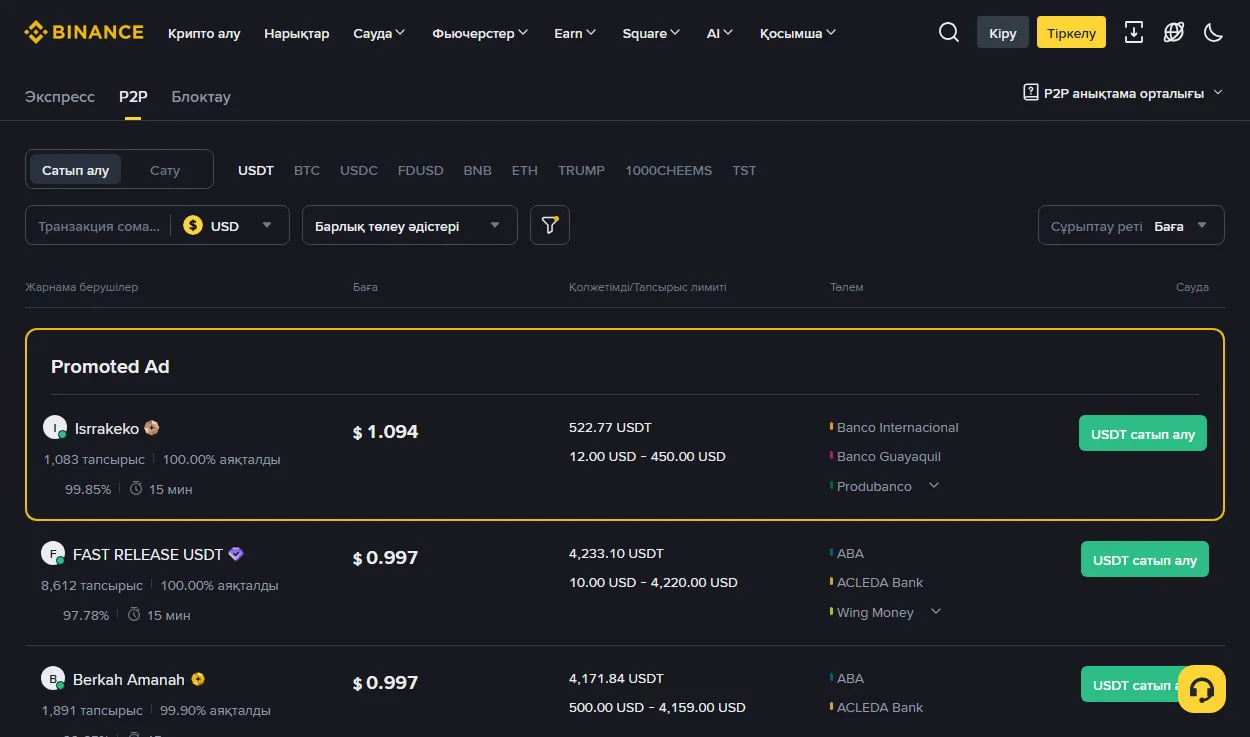
The actual order of operations
The flow is: pick a seller in the exchange's P2P section, open an order that locks quantity and price, the platform holds the seller's USDT in escrow, you send tenge from Kaspi, you mark the order paid, the seller confirms receipt, and escrow releases the coins to you.
The important thing is understanding what escrow actually protects. It protects you against "I paid and got nothing" — as long as you really did pay and can show it, the dispute process generally holds up. It does not protect you against the money itself being tainted. That belongs to banks and law enforcement, and the platform has no reach there.
When choosing a seller I look at these, in this order of importance:
- Completed trades and completion rate. Review history, completion rate and unusual feedback together; these do not establish the safety of the current trade or its funds.
- Account age. Skip new accounts entirely, whatever the price.
- Whether the payee name matches. If you are asked to send to a name that does not match the seller's account, cancel the order.
- Price. Last. Anything far better than the market is itself the signal.
Once the order is open there is one thing you must do: screenshot everything. The order page with its reference number, amount and counterparty ID; the Kaspi transfer confirmation; the in-platform chat. All three. In normal circumstances these are useless. On the one occasion something goes wrong they are the only material you have. You can group these records by date and order reference and keep a separate secure backup, rather than relying on one phone.
Follow the bank and platform order requirements for purpose and reference, truthfully, without disguising the purpose or changing keywords to evade review. If instructions conflict or a counterparty asks you to misstate the purpose, stop and check through official channels. We do not have Kaspi’s internal screening model and cannot claim omitting a word lowers the chance of review.
Why cards get frozen: the real mechanism
Banks freeze accounts on behaviour, not on what the money was for. The bank does not know and does not care that you bought USDT. What it looks at is whether the recent pattern on this account resembles a leg of a laundering chain. That assessment comes out of a model, not a person reading line by line.
| Pattern | Why it looks suspicious |
|---|---|
| Several unfamiliar senders in a short window | Looks like funds being gathered |
| Money leaves immediately after arriving | Account looks like a pass-through, not a wallet |
| In and out amounts nearly equal | Nothing settles, so it does not look like personal use |
| Senders unconnected to each other | Does not match a normal social transfer graph |
| Repeated large round numbers | Ordinary spending is rarely that tidy |
Note that every line above is unremarkable on its own. Receiving money from someone you do not know is normal. Sending money out is normal. What triggers review is the combination — and P2P naturally hits several at once: the counterparty is a stranger, the amounts match because they correspond to the coins, and you may spend it soon after.
There is a worse case, entirely outside your control: the money you received is proceeds of crime. When the upstream case opens, investigators freeze accounts along the payment chain, and yours is on it. At that point whether you were an innocent third party is something you have to demonstrate — with exactly the screenshots described above.
Five arrangements to make before paying
These are record-keeping and verification steps, not ways around bank review. No reduction in screening risk is promised:
One: keep clear payment records
Keep trading and everyday spending records distinguishable, with bank statements, platform orders and source-of-funds evidence. Another card may help bookkeeping, but it does not isolate a freeze: bank or legal restrictions can affect other accounts in your name. Plan essential expenses in advance, and do not use another card to continue unexplained activity.
Two: verify the source and purpose of funds
Check where funds came from, who is being paid and why. Artificially delaying the next transfer does not establish legitimacy or prevent bank review. If a question or restriction already exists, ask the bank what explanation and evidence it needs and retain the complete payment trail. No waiting interval is a safe harbour.
Three: check each counterparty
When buying, you usually pay the seller; when selling, you receive money. Keep those directions distinct. Compare the verified party on each order with the actual payer or payee. Do not split an order to make the statement look different, and do not skip a fresh check merely because you have used the same counterparty before.
Four: follow the actual order amount
Pay the genuine order amount and check that fees, limits and asset quantity match. We have no access to the bank’s internal model and cannot call round or uneven amounts safer. Do not alter the last digits or split payments to evade monitoring. If the amount is incompatible with the bank’s rules, establish an appropriate permitted channel first.
Five: keep evidence, and keep it somewhere else too
Screenshots on the phone, plus a periodic backup elsewhere. Phones get lost, handed over, or simply break. Evidence you cannot reach is not evidence.
These and a few other checks are in a pre-trade self-check — thirty seconds before you confirm, which is easier than remembering the list.
On finding "one reliable seller and sticking with them"
The most common follow-up question. Does a long-term counterparty help?
For counterparty risk, yes — a regular seller is steadier than a new face each time. It does nothing for freeze risk, because that does not turn on whether the person is trustworthy. It turns on where their money came from upstream, and a perfectly honest seller can unknowingly receive tainted funds and pass them to you.
So a regular seller reduces one category and not the other. Do not let familiarity erode the screenshot and separate-card habits — those address a completely different problem.
The scams you will meet
P2P fraud almost always aims at one thing: getting you to press release while you have not truly been paid, or while the payment can still be reversed. Recognise that and the variants become easy to spot.
- Fake payment screenshots. A convincing image of a successful transfer, and pressure to release. Only your own banking app counts.
- Third-party payments. The sender is not the seller on the order. That money may well have been obtained from someone else, and accepting it makes it your problem. Name mismatch, cancel — do not be polite about it.
- Reversible payment methods. Paid through a rail that can be pulled back after you release. Confirm the funds you have are final.
- Moving off-platform. "Fees are lower if we just do this directly." Once you leave, escrow protection is gone and the platform will not help. No exceptions to this one.
- Fake support. Someone contacts you mid-trade claiming to be from the platform. Support does not open private chats with you and never asks you to move funds.
Third-party payments and fake support are two situations to examine carefully; this is not a ranking based on cases documented by this site. The first is hard to refuse because it sounds so reasonable — "my friend is sending it for me" — and it is exactly that one transfer that produces a call from the bank several months later.
Is there another route
Yes, with trade-offs. Platform fiat rails put an institution rather than an individual on the other side, which lowers freeze risk considerably, at the cost of fewer payment methods and tighter limits. Crypto cards skip converting back to tenge through a bank entirely, but work in fewer places. Locally licensed platforms give the cleanest compliance path with a narrower asset range.
If your purpose is holding some USDT for cross-border payments rather than active trading, taking the official fiat rail and living with the limits is the better trade. The P2P price advantage is a thin layer, and one frozen card — the time, the effort, the possible loss — eats through it many times over.
Crypto cards get their own guide. Local entity versus global platform is here. Going the other way, converting back to tenge, has different considerations and is covered in cashing out.
Questions people actually ask
Will Kaspi block my card just for buying USDT?
Banks do not block "buying USDT" as such; they act on patterns the account shows. One ordinary transfer triggers nothing. Many unfamiliar inbound transfers in a short window, matching in and out amounts, and money leaving immediately, in combination, do.
What amount is safest?
There is no safe amount. Use the actual order and funds whose source you can explain. Do not split, alter the last digits or delay transfers to evade bank review. Stop and clarify the requirements if something is uncertain; a small amount does not replace these checks.
If it is frozen, do I get the money back?
It depends what kind of freeze it is. A bank's own control measure can usually be lifted once you provide trade records and explain the source. A freeze at law enforcement request runs a different and much longer path and warrants professional help.
P2P or paying by card directly?
On freeze risk, an official platform fiat rail generally beats peer-to-peer, because your counterparty is an institution rather than a stranger. The cost is fewer payment options and tighter limits.
Risk notice: crypto prices move violently and you can lose everything you put in. What is described here touches on money safety and local financial regulation and is not investment, legal or tax advice. Some jurisdictions restrict crypto assets — check the current rules where you are.
Two kinds of source, kept apart
Platform mechanics come from the platform’s own help pages; the card-freeze material comes from local regulators and law-enforcement notices. They do not carry the same weight, so they are listed separately.Both checked September 2026
- Kaspi.kz official website Kaspi BankTransfer limits, crediting times and risk controls should be read from the bank's current terms.
- Daily official market exchange rates National Bank of KazakhstanWhether the price you are being offered is out of line can be settled against the official market rate.
- Regulation of the digital assets market National Bank of KazakhstanIf your counterparty is in fact running an exchange business, that is a licensed activity.
- Unsecured digital asset exchange operators: licensing conditions National Bank of KazakhstanThis page makes clear how far a person 'buying on your behalf' is from a licensed exchange operator.
- Code of the Republic of Kazakhstan on Administrative Offences Adilet legal information systemThe administrative-law basis behind bank-side risk controls.
- Criminal Code of the Republic of Kazakhstan Adilet legal information systemThe criminal provisions that can come into play where the source of funds is in question.
- AFSA public register of regulated entities Astana Financial Services AuthorityIf the other side claims to represent a platform, check the register first.