
A foreign passport is usually enough to sign up with an exchange and pass identity verification while you live in Kazakhstan — the signup guide covers that part. What the passport does not settle is everything after: whether you can move tenge in and out, what limits a locally licensed platform applies to you, and which country expects your tax return. Those depend on the residence status you hold.
The catch is that Kazakh rules use the word "resident" in at least three different senses. You can be a resident under one and a non-resident under another at the same time, so it helps to separate them before looking at accounts.
Three meanings of "resident" in Kazakhstan
Currency law. Article 1 of the Law on Currency Regulation and Currency Control (No. 167-VI of 2 July 2018) recognises two kinds of individual resident: citizens of Kazakhstan, and foreigners or stateless persons living there permanently on a permanent residence permit. A work visa, a temporary residence permit, a student visa or visa-free entry all leave you a non-resident for currency purposes, however long you have been in the country.
Tax law. Article 222 of the new Tax Code, in force since 1 January 2026, treats an individual as a tax resident if they live in Kazakhstan permanently — at least 183 days in any consecutive 12-month period — or have their centre of vital interests there. The type of permit does not enter into it. Someone on a temporary permit working in Almaty all year is likely a non-resident under currency law and a resident for tax. The crypto tax guide starts from that question.
E-residency. Despite the name, it is neither. The programme's own site says it is not a visa or a residence permit and does not automatically create tax residency.
| Status you hold | Currency law | Tax law | What it means when opening accounts |
|---|---|---|---|
| Permanent residence permit | Resident | Days and centre of interests decide | The IIN is printed on the permit; closest to the process citizens go through |
| Temporary residence permit or work visa | Non-resident | Usually resident after 183 days | IIN is obtained separately; the permit's expiry date matters for document checks |
| Visa-free or short-term entry | Non-resident | Usually not | Hardest to open a local bank account; the tenge route is most limited |
| E-resident | Not applicable | Does not create residency | The IIN works in digital channels only and does not open eGov |
The tax column shows the typical case only; your own day count is what decides it.
Who the retail limits on AIFC platforms apply to
Trading platforms licensed in the Astana International Financial Centre carry a retail cap. In AFSA's own words, a retail client "can now only invest up to US$1,000 per month without providing proof of income or assets", or up to 10% of annual income or 5% of net worth — whichever is lower — to a maximum aggregate of US$100,000 once income or assets are confirmed.
Who that requirement lands on is set by the rulebook. Rule 2.11.2 of the AIFC Rules on Digital Asset Activities requires a trading facility operator to have systems ensuring that "a Retail Client, who is a resident of the Republic of Kazakhstan" complies with the limits in the AIFC currency regulation rules. Residence there follows the currency-law meaning above.
Read literally, a foreigner on a temporary permit or visa-free stay is not the client that rule names. That does not mean the platform sets no limits for you: how it classifies residence, and what it asks of non-residents, sits in its own onboarding questionnaire and client agreement, and we have not checked every platform. When the form asks whether you are a resident of Kazakhstan, answer in the currency-law sense unless it says otherwise.
Binance Kazakhstan is one example. Section 2.1 of its terms (last updated 23 April 2025) lists eligibility — 18 or older, not a Restricted Person, no existing Binance Kazakhstan account, and so on — and does not make Kazakh residence a condition for individuals. Section 7.1-1 says anyone opening an account as an individual is classified as a Retail Client. How it differs from the global platform is in a separate comparison; to confirm any platform's licence yourself, use the AFSA register walkthrough.
The IIN and the tenge leg
The IIN (individual identification number, ИИН) is Kazakhstan's 12-digit number for individuals. An exchange account may need only your passport, but tenge deposits and withdrawals pass through a Kazakh bank account, and that is where the IIN becomes unavoidable.
- With a permanent residence permit, the number is on the card already.
- Foreigners staying temporarily have a dedicated eGov service, "Формирование ИИН иностранцам и лицам без гражданства, временно пребывающим в РК" (IIN for foreigners and stateless persons staying temporarily). Check that page for current channels and documents; we could not open it to verify the details.
- The IIN issued to e-residents is a different thing — see the next section.
Once the bank side is in place, the route back from the platform is in the tenge cash-out guide. Holding a foreign passport does not make source-of-funds questions less likely; the checklist in the bank enquiry guide applies equally.
Can e-residency stand in for a residence permit?
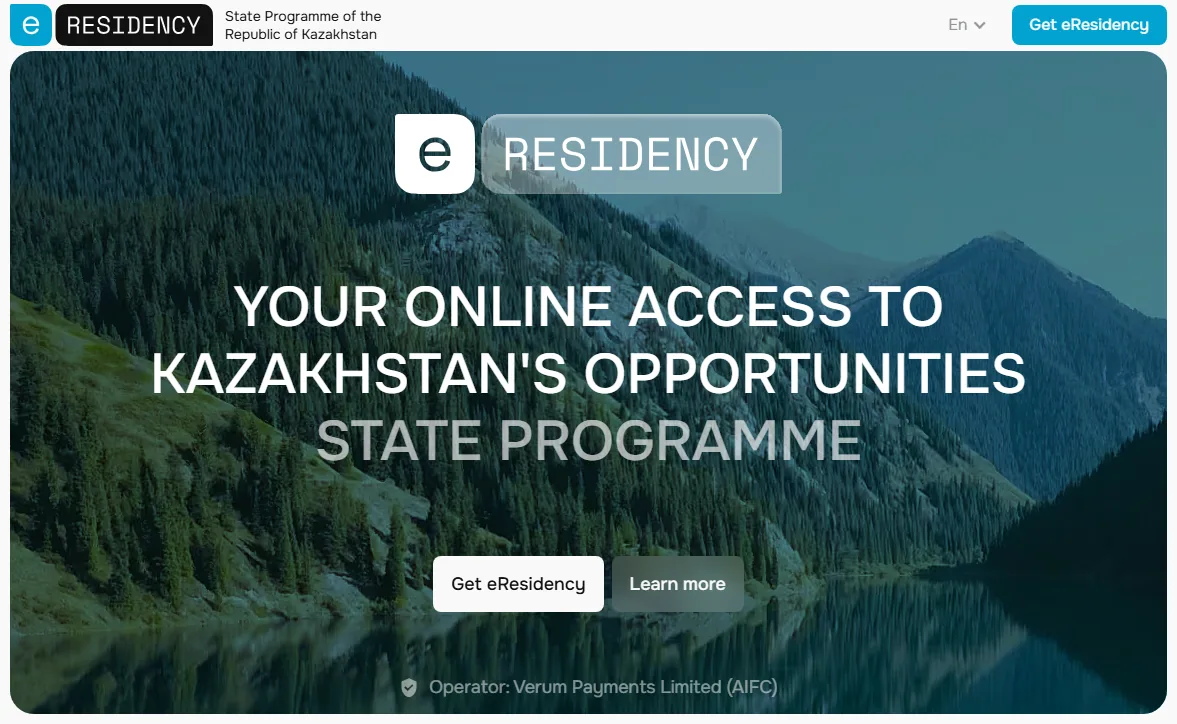
No, and it does not claim to. According to the programme site in October 2026:
- after online identity verification you receive a digital identity card and an IIN "for use in digital environments";
- listed uses are remote account opening at partner banks (Freedom Bank, RBK Bank, Bereke Bank), investment services through licensed brokers, and company registration in the AIFC; the only crypto exchange named is ByBit, marked "coming soon";
- it gives no access to eGov or eLicense, is not a visa or residence permit, and does not create tax residency;
- residents of sanctioned jurisdictions cannot apply, and partner banks run their own AML checks and decide on accounts themselves;
- the fee is shown as US$120 a year, labelled a temporary promotional price.
If you already live in Kazakhstan with a permit, e-residency adds little to opening an exchange account. It is built for people outside the country who want a Kazakh bank account remotely. Note too that "State Programme" in the header sits above a private operator, so prices and the partner list can change.
New passport, new permit, leaving the country
Foreigners have one variable citizens mostly do not: expiry dates. Renew a passport, extend a temporary permit or switch to permanent residence, and the documents on your exchange account are out of date. Binance Kazakhstan's terms require the information you give to be "complete, accurate and truthful"; finding out your ID has lapsed when a withdrawal triggers re-verification is the worst moment to deal with it.
After any renewal, update the documents through the platform's own flow. If your currency-law status changed — a permanent permit turns you into a resident — go back and check the residence answer you gave at onboarding.
Do not open accounts in a local friend's name. Borrowing someone's IIN, card or account to get around foreigner restrictions breaks the one-person, truthful-information terms platforms impose, and can fall under Article 232-1 of the Criminal Code on handing over accounts and receiving transfers for others. If the account gets frozen, the money is legally theirs.
Leaving Kazakhstan raises its own questions — which account to close first, what happens to tax residency — that depend on where you go next, and are not covered here. If verification was rejected, the symptom-by-symptom table is the place to start.
Questions
I only have a passport and no residence document. Can I open an account with a local licensed platform?
The exchange account itself may be possible; eligibility depends on each platform's terms, and Binance Kazakhstan's individual eligibility clause does not require Kazakh residence. The usual sticking point is tenge: without an IIN and a local bank account, getting money in and out means workarounds that tend to cost more and carry more risk.
The form asks if I am a resident of Kazakhstan. I have a temporary permit. What do I tick?
If the form does not define the term, the currency-law definition counts only citizens and permanent-permit holders as individual residents, so a temporary permit makes you a non-resident. If the form says it means tax residency, use the 183-day test. When unsure, ask the platform's support which meaning it uses and keep a screenshot of the reply.
Laws, rules and official pages used
For limits and documents applied to non-residents, only Binance Kazakhstan's terms were checked; other platforms were not.
- Law on Currency Regulation and Currency Control, No. 167-VI of 2 July 2018 Әділет legal information system (Russian)Article 1, definition of residents; checked in October 2026 against a published copy of the law text, as the Әділет page would not load at the time.
- AIFC introduces limits for Retail Clients on buying and trading of Digital Assets AFSAUS$1,000 per month, 10% of income or 5% of net worth, US$100,000 aggregate; no publication date shown, read October 2026.
- AIFC Rules on Digital Asset Activities (FR00062 of 2023) AIFC, PDFRule 2.11.2 on investment limits; version with amendments commencing 1 January 2025.
- Binance Kazakhstan Terms and Conditions BN KZ Technologies LimitedSection 2.1 eligibility, Section 7.1-1 retail classification; marked last updated 23 April 2025.
- eResidency Programme site, operated by Verum Payments LimitedUses, limitations and fee; read October 2026.
- Criminal Code of the Republic of Kazakhstan Әділет legal information system (Russian)Article 232-1, current text applies.
The 183-day test in Article 222 of the 2026 Tax Code is taken from a Kazakh accounting information service's summary of the new code; the article text itself was not checked word for word.