On an exchange licensed in the Astana International Financial Centre (AIFC), sending crypto to another platform or to a private wallet now starts with a short form: who is receiving it, which country they live in, what the transfer is for, and whether the destination is an exchange or a self-hosted wallet. The form comes from the regulator: Chapter 11-1 of the AFSA Anti-Money Laundering Rules requires licensed firms to collect and pass on sender and recipient details with each transfer. The international name for this is the Travel Rule.
The help page says that when the details are complete and correct, the transfer is processed normally. It gets awkward in three situations: the wallet is your own, the amount is small, or you do not actually know the recipient's full name. Each one is covered below, against the rule text and the platform's own help pages.
What the rule requires: names are needed below USD 1,000 too
Rule 11-1.1 of the AFSA AML Rules covers transfers between digital asset service providers. The sending platform must obtain and hold the originator and beneficiary information and pass it, immediately and securely, to the receiving platform. For transfers involving individuals the rule sets two tiers:
- Below USD 1,000: the sender's name and wallet address or account number, and the recipient's name and wallet address or account number.
- USD 1,000 or more: all of the above, plus one more identifier for the sender: physical address, national ID number, customer ID, or date and place of birth.
So the line at USD 1,000 changes how much is collected about the sender; names travel with small transfers too. How many questions a platform actually puts on screen is its own design; Binance Kazakhstan, used as the example below, asks on every deposit and withdrawal that involves another exchange or a private wallet.
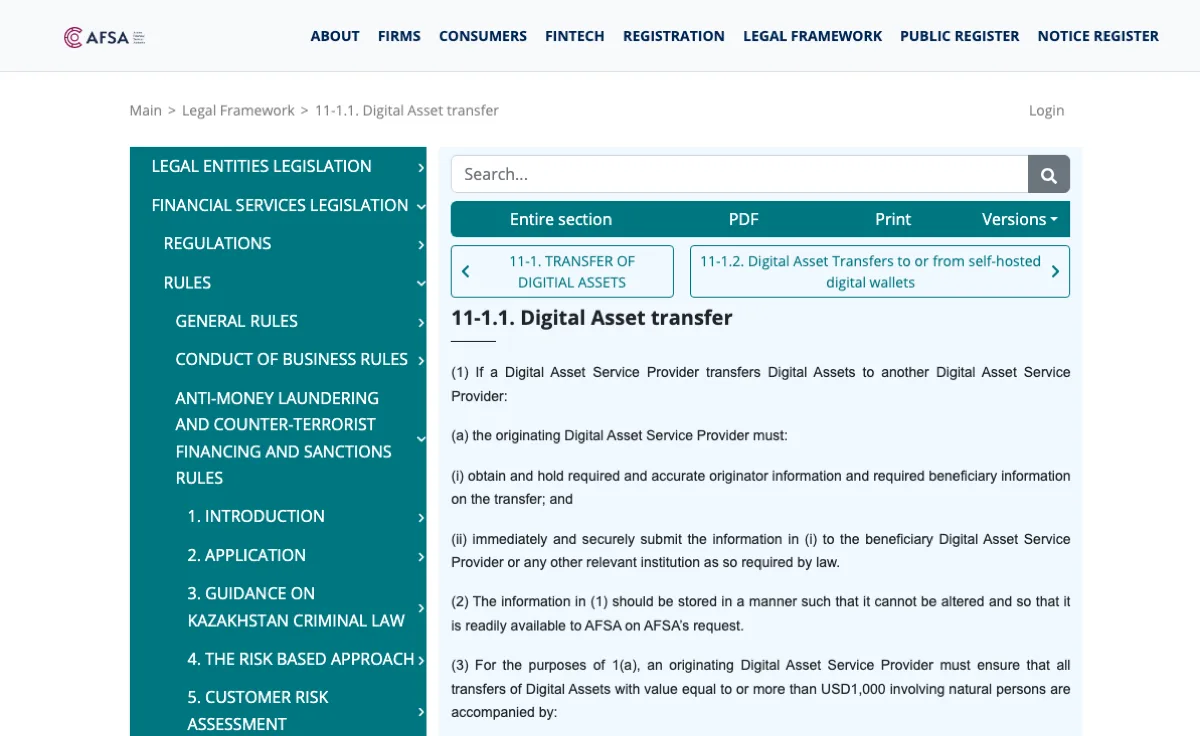
Two more paragraphs in the same section are worth knowing. Paragraph (8) says that transfers from the same sender which appear to be linked are added together when the value is assessed, so splitting USD 3,000 into four transfers of USD 750 is still treated as a USD 3,000 transfer. Paragraph (2) says the information has to be stored so that it cannot be altered and can be produced whenever AFSA asks for it. Whatever you type into that form becomes part of a permanent record.
Transfers to or from private wallets, which the rule calls self-hosted wallets, are in 11-1.2. The platform still collects the same details from its client. Above USD 1,000, or where money laundering is suspected, it has to take extra risk-based measures. The accompanying guidance lists examples: closer monitoring, checking whether the sender or recipient really owns or controls the wallet, accepting such transfers only once the wallet is assessed as reliable, and setting limits or refusing them.
On timing and scope: the rulebook notes that Chapter 11-1 took effect 12 months after the AIFC Rules on Digital Asset Activities commenced, and the Binance Kazakhstan help page says its Travel Rule feature fully launched in late 2024. All of this is AIFC law. How platforms licensed by the National Bank outside the AIFC handle transfer information was not checked for this guide.
The four questions on the withdrawal form
Wording differs from platform to platform. The example here is the Binance Kazakhstan help article “Travel Rule on Binance Kazakhstan: What You Need to Know”. Deposits ask about the sender, withdrawals about the recipient, and both ask four things.
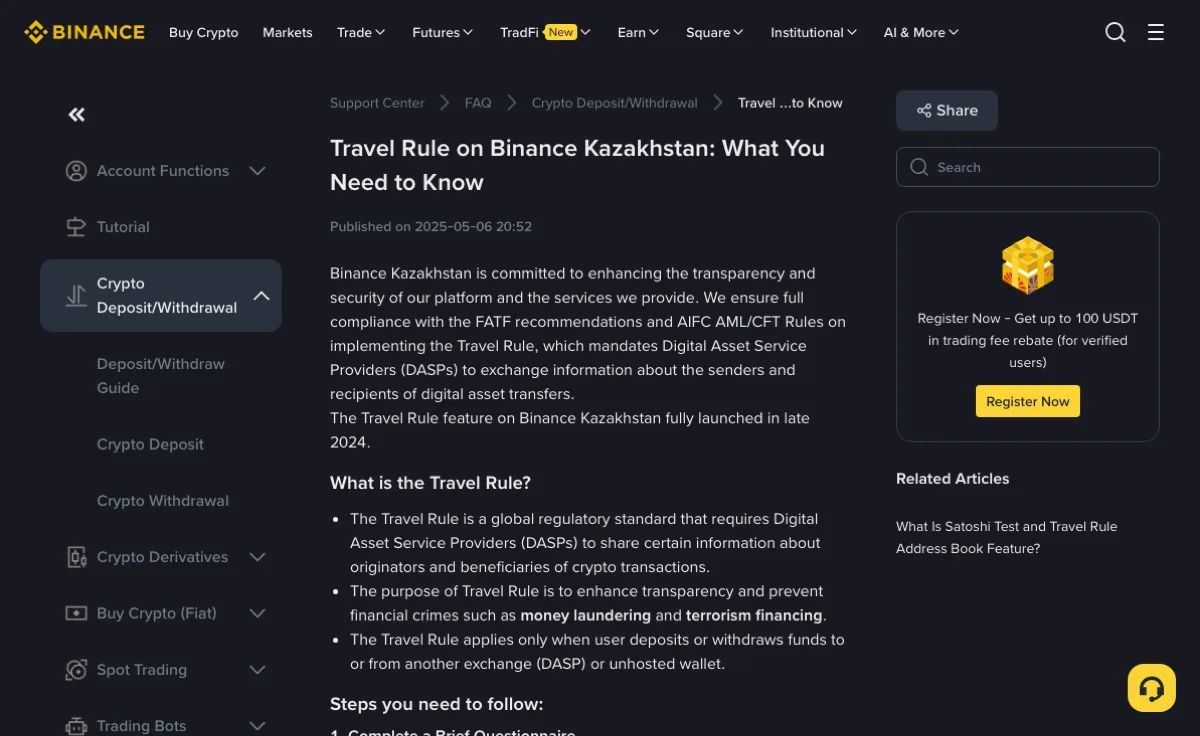
- First name and last name. The recipient's legal name, not the label you gave the address or their Telegram handle. The help page does not say whether Latin or Cyrillic spelling is expected. If the money is going to another platform, ask the recipient how their name appears on that platform's verified profile and use that.
- Country of residence. The country where the person lives. A Chinese or Russian citizen living in Almaty sending to themselves would put Kazakhstan.
- Purpose of the transaction. Say what the transfer is actually for: moving funds to your own wallet for safekeeping, paying for a specific shipment of goods. A specific purpose gives the reviewer something to check against. Paying for trade in USDT has its own pitfalls, covered in the guide to trade payments in USDT.
- Exchange or private wallet. If the address belongs to an exchange, say so and pick it from the list. A brand's local Kazakh entity and its global platform are different companies with different contracts; the local-versus-global guide explains the difference.
The help page adds that when the platform asks for information you have 7 days to respond, and that the questions come up every time, even for an address you have used before, because the recipient or purpose may have changed. The address book in the next section saves some of that typing.
Withdrawing to your own wallet: the Satoshi Test
The Travel Rule still applies when the private wallet is yours. The help page is direct about it: give your own details.
To avoid filling the form each time, save the address and prove you control it with a Satoshi Test. The steps below follow the Binance Kazakhstan article “What Is Satoshi Test and Travel Rule Address Book Feature?”, updated 3 February 2026:
- Open Address Management and click [Add], then [Add address].
- In the “Save address” window, enter a label, the coin, the address and the network, then click [Save].
- When the “Verification Reminder” appears, click [Verify Now].
- Choose “I am sending the funds to myself” and “Private Wallet”.
- Pick the verification method and the test token, submit, then send the exact amount shown from that wallet to the deposit address given. The help page's example is 0.00000208 BNB on BSC.
- The address shows “Pending”, then “Verified” once the deposit arrives. The test amount is credited to your account.
Step 5 needs the most care: the amount has to match to the last digit, on the coin and network specified. A failed test can be repeated.
Once an address is verified, later withdrawals to it come with the form pre-filled. It also gives the platform what the AFSA guidance asks it to look for, namely evidence that the wallet really belongs to you. How to keep the seed phrase itself safe is covered in the self-custody guide.
A wallet that belongs to someone else cannot be tested this way. For that case the help page has you choose “I am sending the funds to another beneficiary”, “Individual” and “Private Wallet”. The address is then marked “Declared”: you have stated that the details are true, accurate and complete.
If you cannot name the recipient, stop there
One of the help page's own questions is: “I'm transferring my token to someone I got to know on the internet. I don't know the beneficiary's full name.” The answer is to contact them and get the correct details; the transfer will not go through with incomplete or inaccurate information.
The page leaves it at that. In Kazakhstan, these are situations where you may be unable to name the recipient: a P2P buyer asking you to skip the platform and send USDT straight to an address; a “platform manager” or “AFSA-certified adviser” telling you to withdraw to an address to “activate” or “unfreeze” an account; or someone asking you to take tenge into your card and send USDT on for them.
Typing a made-up name does not make the problem go away. Under paragraph (2) of 11-1.1 that record is kept unaltered and is available to AFSA on request. Receiving and forwarding money for someone else can fall under Article 232-1 of the Criminal Code, see the guide to lending your card. For P2P payments that turn out to be stolen money, see triangle scams; for people posing as AFSA, see fake AFSA channels.
Before a P2P deal you can run through the P2P payment risk check. It runs locally and nothing you enter is uploaded.
Withdrawal held or bounced: which case is it?
According to the help page, details that do not match or are incomplete mean a longer review; the platform may contact you to clarify, and if the information is still not right the transfer can be delayed or rejected. Paragraph (7) of 11-1.1 says a provider should not execute a transfer that lacks the required information and should return the amount to the originator. On a withdrawal, the originator is your own account.
When the problem is an incoming deposit, you are the one answering questions about the sender. If you cannot give their name or country, ask them first. What happens to a rejected deposit, and whether it goes back to the sender, is not stated on the help page and was not established for this guide.
Some transfers are blocked outright. The help page says transfers to and from certain countries and regions, including Iran, North Korea, certain regions of Ukraine and other high-risk jurisdictions, are prohibited and blocked automatically; the full list is in the Terms of Use. No amount of extra paperwork changes that.
If you supplied everything within 7 days and the platform still sits on the withdrawal without explanation, keep the withdrawal ID, the date you replied and every response, and follow the order in the guide to complaining about a licensed platform. Turning the coins back into tenge is covered in cashing out to tenge.
Questions
I'm only withdrawing USD 200 of USDT. Do I still need the recipient's name?
Yes. Paragraph (4) of AFSA AML Rule 11-1.1 requires the names and wallet addresses of both sides for individual transfers below USD 1,000 as well. What drops away below that line is the extra identifier for the sender, such as an address or ID number. Binance Kazakhstan's help page says the questionnaire is asked on every deposit and withdrawal involving another exchange or a private wallet.
Can I verify a wallet address once and stop answering the form?
Partly. Once an address is verified with a Satoshi Test or declared in the address book, the form is pre-filled with the stored details for later withdrawals to it. The help page still describes the information as collected for every transaction, because recipient and purpose can change.
Rule text and help pages
All pages opened and checked in November 2026. The AFSA rulebook is the current version linked from the AIFC website; publication and update dates for the Binance help pages are as shown on those pages.
- AML Rules 11-1.1. Digital Asset transfer AFSA rulebookThe two USD 1,000 tiers, paragraph (2) on tamper-proof storage, (7) on not executing and returning funds, (8) on aggregating linked transfers.
- AML Rules 11-1.2. Transfers to or from self-hosted digital wallets AFSA rulebookSame information for private wallets; extra risk-based measures above USD 1,000 or on suspicion.
- Guidance on risk mitigating measures for self-hosted wallets AFSA rulebookMonitoring, ownership checks, limits or prohibition; the 12-month commencement note for Chapter 11-1.
- Travel Rule on Binance Kazakhstan: What You Need to Know Binance support, published 2025-05-06The four questions, the 7-day reply window, own-wallet transfers, unknown recipients, prohibited countries.
- What Is Satoshi Test and Travel Rule Address Book Feature? Binance support, updated 2026-02-03Adding an address, the Satoshi Test steps, Verified and Declared statuses.